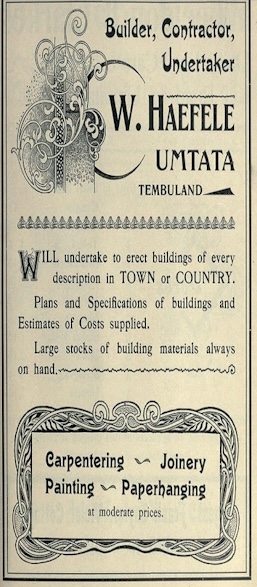
Wilhelm Frederick Haefele

1861 – 1937
Wilhelm was a Trappist noviciate sent, to South Africa, as part of a group of some 33 Trappist missionaries. After some two years of severe drought in the Port Elizabeth region the group was sent to Natal where they established the Marion Hill Monastery. Wilhelm left the Order and headed to the newly established village of Umtata. It was there that he spent the greater part of his life.
The architectural history of All Saints Catholic Cathedral records that Mr Haefele, described as an ex-Trappist Brother, directed alterations to the church in 1893.
Those were difficult times. Wilhelm took on the responsibility for the well-being of a number of orphaned and abandoned children. During this time he arranged for an acquaintance he knew back in Germany to join him so as to care for the children. Augusta Hirsch, a young Jewish girl from Rosenheim, near Stuttgart.
Wilhelm and Augusta were later married and, in addition to the six adoptees, had two children of their own. Mary was born on 3 August 1897 and Joseph on 3 January, 1900.
Augusta passed away on the 14th of September, 1904 at the age of 30.
The impact on the family and home would have been devastating. We know Wilhelm was running a building business – and taking care of eight children.
Augusta’s young sister, Frieda, came to Umtata to care for the children. There must have been much correspondence and many months of travel before she would have arrived.
Wilhelm and Frieda were married in about 1904 (date not known) and had eight children of their own.
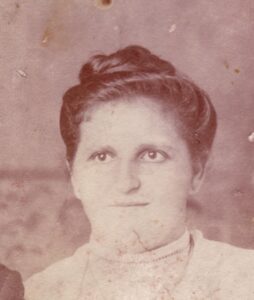
Frieda Haefele (nee Hirsch)
Children:
Henry William
Anne Mary 12/04/1905
Magdalena Agnes 07/11/1907
Francis Xavier 10/05/1909
Aloysius John 18/03/1911
Anthony George 04/03/1913
Augusta Theresa
Maris Stella 27/10/1914
All Saints Catholic Cathedral, situated at the corner of Craister and Leeds Streets.
In 1893 the church was altered under the direction of Mr. Haefele, an ex Trappist Brother.
The work included incorporating the sacristy into the church and moving the altar into the enlarged space.
This is an important finding for your family history.
It establishes that a man named Haefele, identified specifically as an ex-Trappist Brother, was directing alterations to the Catholic Church in Umtata in 1893.
It also establishes that his involvement was not merely that of an ordinary parishioner. He was entrusted with directing building work on a significant religious building.
I have not yet established whether he was formally trained as an architect, builder or stonemason. His role in directing the work does, however, suggest that he possessed practical building knowledge or experience that the church authorities valued
Wilhelm settled in Umtata around 1880, – arrived before the Catholic Church had been built.
He would have witnessed the arrival of priests, the establishment of the parish and the construction of the first church building.
He also would have seen the town acquire municipal government in 1882.
His working life might have involved building, repairs, construction supervision or other practical work.
The church would have been a significant social centre for Catholic families.
The presence of Irish Catholic soldiers also meant that the congregation included people whose backgrounds differed from those of the civilian European settlers.